
Product care
How to care for a Damascus steel chef's knife
By Hurugo · · 5 min read
A good Damascus chef's knife can last a lifetime, and it only asks for a few simple habits in return. This guide covers everything we recommend to Soshida customers: how to clean it, what to cut on, when to hone and when to sharpen, and how to store it.
What Damascus steel is
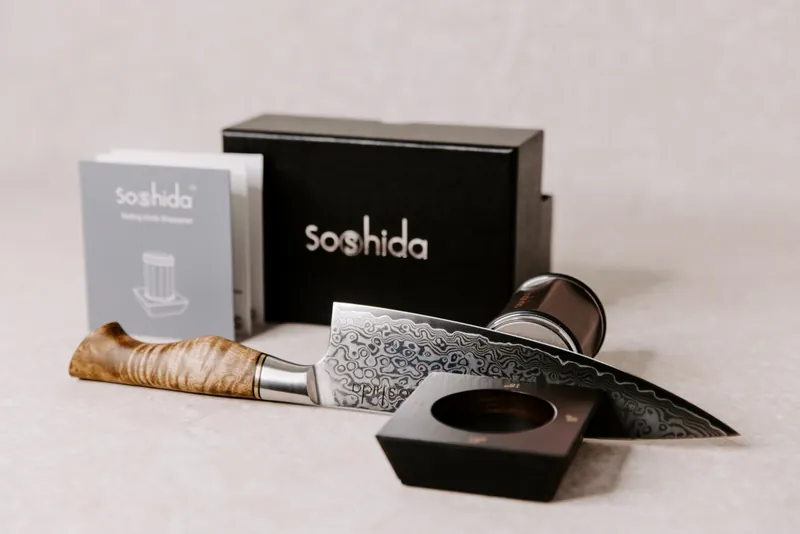
Modern Damascus steel is made by forge-welding layers of different steels together. Once the blade is shaped, it is etched, and because each steel reacts differently, the layers appear as the flowing pattern on the surface. Many Damascus kitchen knives pair those decorative layers with a hard steel core that forms the cutting edge.
Harder steel holds a fine, sharp edge for longer, but it is less forgiving of twisting, prying, and impact than a softer Western blade. Almost every rule below follows from that.
Clean it by hand, and dry it straight away
- Never use the dishwasher. Heat, harsh detergent, and knocks from other cutlery dull the edge, can damage the handle, and may cause spotting.
- Wash by hand with warm water and a little mild dish soap, using a soft sponge. Wipe from the spine towards the edge, never along the edge.
- Dry the blade and handle thoroughly with a soft towel immediately after washing.
- Rinse the blade soon after cutting acidic foods such as tomatoes, citrus, or onions, rather than leaving it to sit.
Choose the right cutting board
Your board does more to your edge than anything else in the kitchen. Wood, particularly end-grain, is the kindest surface, and good-quality plastic or rubber boards are also fine. Avoid glass, stone, marble, ceramic, and steel, which can chip or roll a fine edge in a single cut.
Honing and sharpening are not the same thing
Honing realigns an edge that has rolled slightly through use. It removes little or no metal and can be done often, even every few uses. Use a ceramic or fine honing rod with light pressure, rather than a coarse steel.
Sharpening removes metal to create a fresh edge. For most home cooks, that means every few months, depending on how much you cook.
How to sharpen a Damascus knife
- Choose your tool. Whetstones give the best result. A medium stone (around 1000 grit) sets the edge, and a fine stone (around 3000 to 6000 grit) refines it. A guided or rolling sharpener is an easier option that holds a consistent angle for you.
- Match the original angle. Many Japanese-style chef's knives are sharpened at around 15 degrees per side. Follow the angle your knife was made with.
- Soak or wet the stone as its maker recommends, and set it on a damp cloth so it cannot slip.
- Sharpen with light, even strokes along the full length of the edge, until you can feel a slight burr along the opposite side.
- Repeat on the other side, then move to the finer stone and lighten the pressure.
- Clean and dry the knife to remove any metal particles.
Store it safely
Never store a fine knife loose in a drawer, where it knocks against other utensils. A magnetic knife block or wall strip, a slotted block, or a blade guard all protect the edge. When placing a knife on a magnetic strip, put the spine on first and roll the blade onto the magnet, so the edge never strikes it.
Prevent rust and stains
Moisture is the enemy. Dry the knife thoroughly after every use and store it somewhere dry. If you notice a light spot, remove it gently with a non-abrasive cleaner and a soft cloth, then wipe the blade with a thin film of food-safe mineral oil if you will not be using it for a while.
What not to do
- Don't cut through bones, frozen food, or hard shells. Use a cleaver or a heavier knife instead.
- Don't twist or pry with the blade, or use it to open packaging.
- Don't scrape food off the board with the edge. Turn the knife over and use the spine.
- Don't leave it soaking in the sink.
Look after the handle too
Wooden handles appreciate the same care as the blade: wash quickly, dry immediately, and never soak. If the wood starts to look dry, a few drops of food-safe mineral oil, rubbed in and left to absorb, will restore it.
Soshida knives
Soshida's range includes Damascus steel and hammered-finish chef's knives, along with sharpeners and magnetic knife storage to keep them at their best. Explore the range on the Soshida brand page or shop at soshida.com.
Frequently asked questions
Can a Damascus steel knife go in the dishwasher?
No. Dishwasher heat, harsh detergent, and contact with other items dull the edge, can damage the handle, and may cause spotting. Always wash a Damascus knife by hand and dry it straight away.
Will the Damascus pattern wear off?
The pattern comes from the layers in the steel itself, so it does not simply wear away with use. Heavy polishing can make it fainter over the years, and a knife specialist can bring it back by re-etching the blade.
How often should I sharpen my chef's knife?
Most home cooks need to sharpen every few months, depending on use. Honing regularly in between keeps the edge aligned and extends the time between sharpenings.
Do Damascus knives rust?
Many Damascus knives are made with stainless or rust-resistant steels, but any fine blade can spot if it is left wet. Dry it straight after washing and store it somewhere dry.